Age of Steam Strategy Guide: the Fundamentals, Then Your First Turn
August 29, 2026
This guide assumes you know the rules. If you are new, read How to Play first. Examples use this site's default setup: Rust Belt, 4 players, 8 turns.
Fundamental 1 · It is an income-track game
Final score is income track × 3 + completed link tiles × 1 − issued shares × 3. A link tile is worth 1 point; one step of income is worth 3. Track is not the score — it is the machine that raises your income track.
Income rises when goods cubes are delivered. Each link the cube crosses pays +1 income to the link's owner. The same delivery is good or bad depending on how many of your own links it crosses — deliver over an opponent's links and you are paying them.
Fundamental 2 · Shares are debt
Issuing a share gives you $5 immediately, then costs $1 every turn and −3 VP at game end. A share issued on turn 1 of an 8-turn game costs $8 in expenses plus 3 points. You need shares to fund early track, but every extra share raises your per-turn expenses and your bankruptcy risk. How many to issue is covered with data in a separate article.
Fundamental 3 · Your engine is your delivery range
The engine number is how many links one delivery may cross. At engine 1 you can only deliver to an adjacent city. A bigger engine reaches farther cities, and longer deliveries pay more income — but the engine also adds $1 to your expenses each turn. Upgrading once in the early-middle game usually pays for itself through longer late-game deliveries; forcing it on a tight turn does not.
Fundamental 4 · The auction is a fight for position
Player order is auctioned every turn. Acting first lets you claim the action and the building space you want, at the price of cash. In this implementation the first player to drop pays nothing, mid drops pay half their last bid, and the final two pay in full. Spend on the auction only when a specific action matters to your plan; on a tight turn, dropping early is usually right.
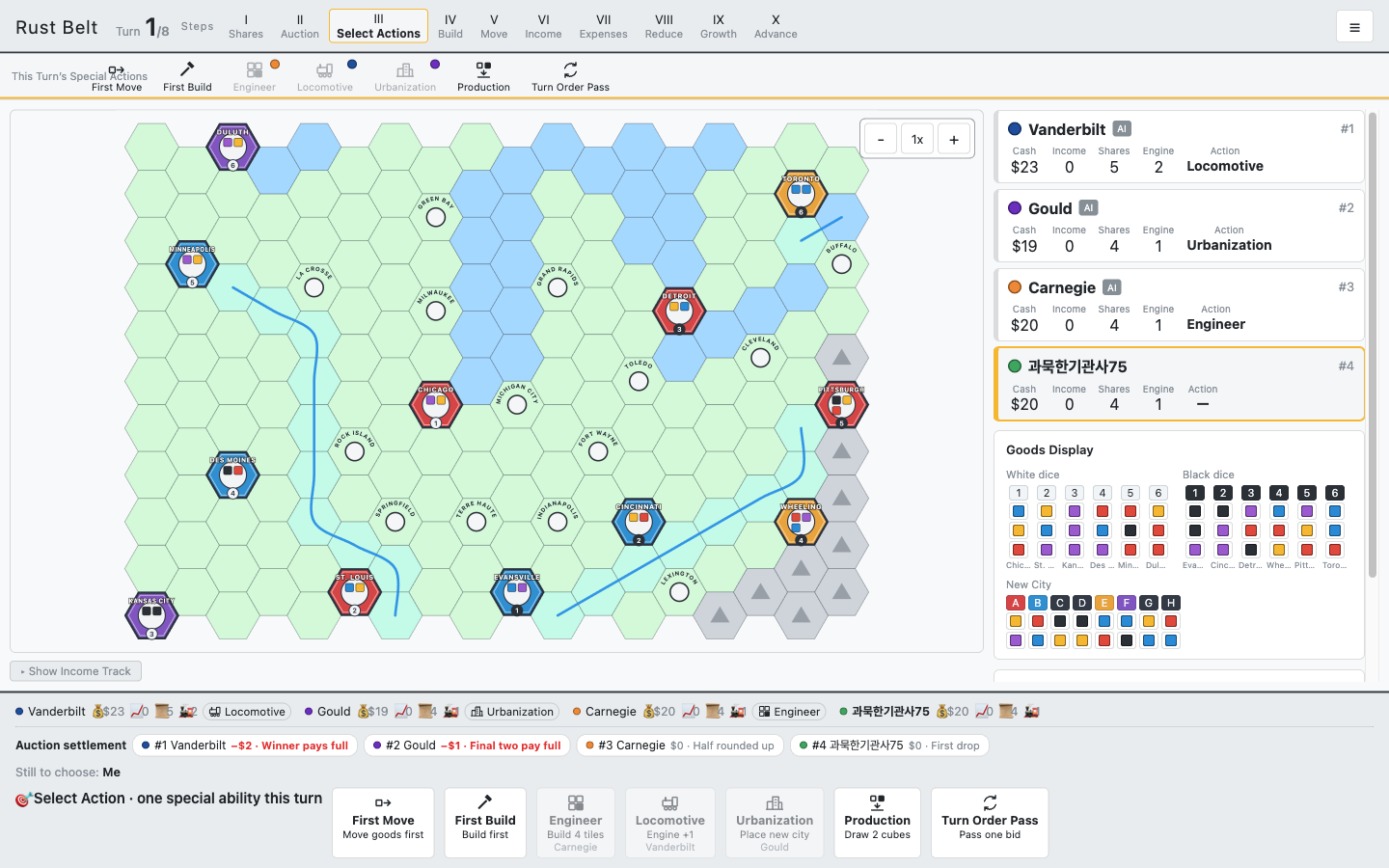
Applying it on turn 1 (Rust Belt, 4 players)
Turn 1 has four decisions: shares, auction, action, build. The trick is to plan the route first and work backwards.
- Pick the route first. Find a city holding cubes whose color matches a nearby city. The turn-1 goal is not a grand network — it is 1–2 links that can deliver next turn.
- Cost it. You start with $10. Plain-terrain track runs about $2 per tile; rivers and mountains cost more. Two links (3–5 tiles) typically cost around $10.
- Issue only the gap. Once the route is costed, the share count falls out. Measured: 64% of 239 completed games issued exactly 2 shares on turn 1 (mean 2.13; 2–3 shares in 88%).
- Do not overbid. On turn 1 everyone has the same cash, so auctions overheat. If no remaining action is essential to your route, take the free first drop.
- Build to plan. Three tiles per turn maximum. Incomplete track loses ownership if not extended next turn, so do not leave stubs you cannot finish.
The turns after
From turn 2 the loop repeats: deliver for income, spend income on track, grow the engine for longer deliveries. From mid-game, slow the share issuing and treat the income track itself as points. Late shares have no turns left to repay themselves — they are simply −3 VP.
All figures in this article are measured from completed games on this site (246 completed games through August 2026, operator accounts excluded). They describe play on this implementation, not tournament play with the physical game.
Start a Rust Belt game now Quick Start with 4 players; if you have a saved game, the map is only selected
More strategy articles
- How Many Shares Should You Issue in Age of Steam?
- Which Age of Steam Map Is Hardest? Numbers from 246 Games
- Which Age of Steam Map Should You Play First?
- Survive Turn One and You Will Probably Finish
- Age of Steam, Steam, Railways of the World: One Game, Three Lineages
- Ireland: The Map Where the Cubes Emigrate
- Making the Bupyeong Underground Map: From a Guestbook Post to a Board in 42 Hours
- How We Trained the AI Opponents, and the Three Times It Went Wrong
- Rust Belt: Why the Default Map Is a Place That Had Not Rusted Yet
- Korea: The Map Where Cities Have No Colour and the Cheapest Link Is the First Railway
