Rust Belt: Why the Default Map Is a Place That Had Not Rusted Yet
September 7, 2026
Open the box and the first board is Rust Belt. It was the only board in the 2002 edition, it is the first of the six maps in the 2019 Deluxe Edition, and every example in the rulebook is played on it. It is the Quick Start default on this site too. One look at the map explains why.
The name came later
"Rust Belt" spread in the 1980s, when the factories closed and the people left. The usual story credits Walter Mondale telling Cleveland steelworkers about a "rust bowl" in 1984; a rival claim points to an AP story in 1982. Either way, it is a name for decline.
Now look at the cities on the board. Chicago, Pittsburgh, St. Louis, Detroit, Duluth. The years when those cities poured out cubes were around 1900, when nobody called this the Rust Belt. It was the Steel Belt: Minnesota ore and Pennsylvania coal meeting by lake and by rail to become iron. The map draws the logistics of that era. The name points at what came after.
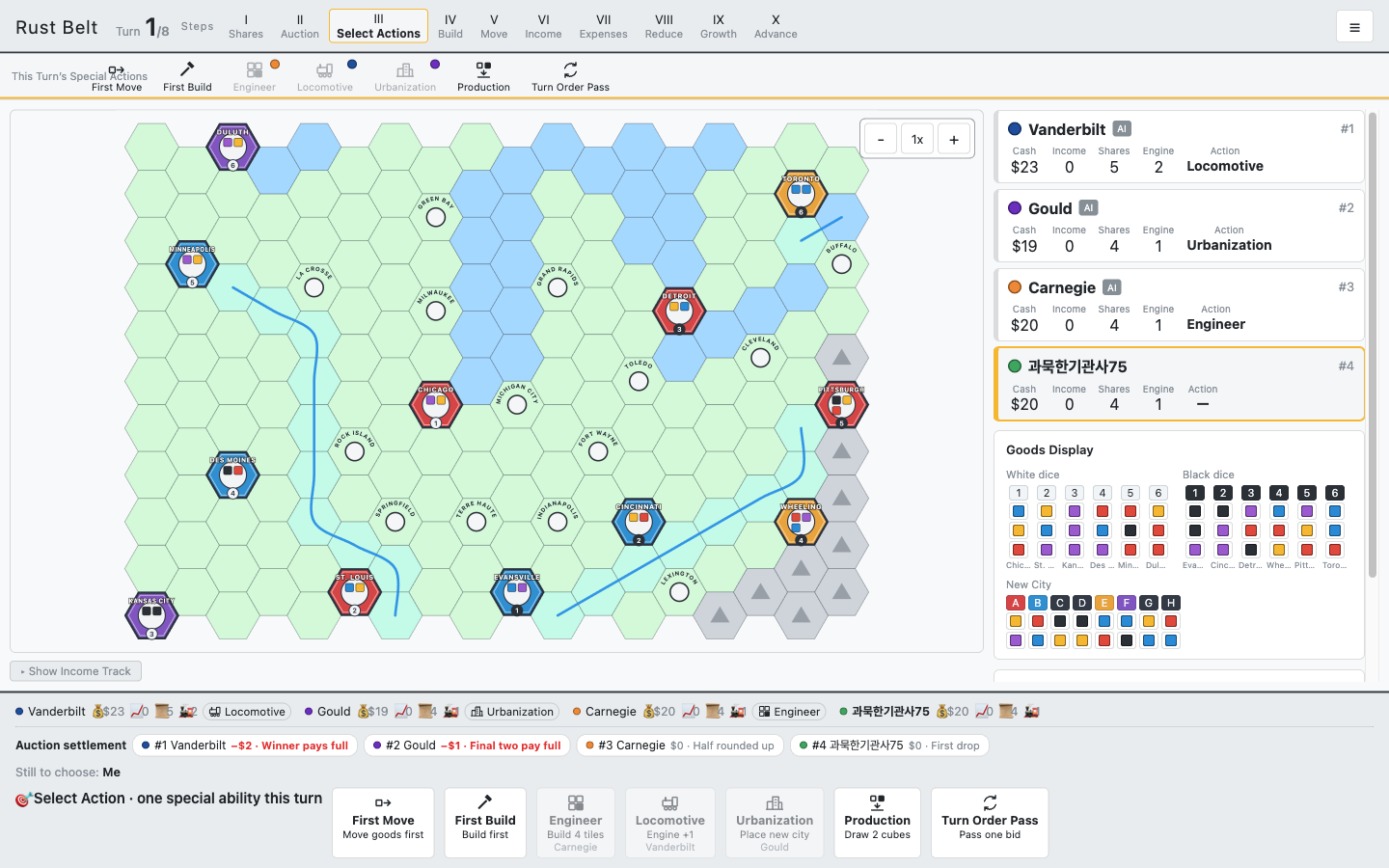
Three rivers, nine mountains, 26 lake hexes
The board is 189 hexes: 109 plains, 19 river, 26 lake, 9 mountain. The rivers come in three runs that match real watersheds. The Mississippi, ten hexes, drops south from below Duluth past La Crosse and Rock Island to St. Louis. The Ohio, six hexes, runs southwest past Cincinnati. The upper Ohio by Wheeling and the Niagara near Toronto make three more. All nine mountains sit at the eastern edge around Pittsburgh and Wheeling: the Appalachians.
So the east is rich and expensive. Only two cities start with three cubes, Pittsburgh and Wheeling, and both are ringed by mountains. In 1911 Pittsburgh made 59% of America's structural steel; Wheeling was the Nail City. Where the cubes are is where the iron was, and the iron came from the coke fields over those hills.
The 26 lake hexes cannot be built on. In reality Lake Michigan and Lake Erie were the railway's competitors. More than five million tons of iron ore left Duluth by ship in 1900 for Cleveland and Conneaut, and when the Chicago rail yards clogged, grain went by boat because it was cheaper. The map leaves the lakes empty and hands the player nothing but rails. It is the clearest place to see where this game's abstraction draws its line.
What became a city, what became a town
By 1900 population, Cleveland was the seventh largest city in the United States (382,000), Buffalo eighth (352,000), Milwaukee fourteenth (285,000). All three are towns on this map, not cities. Wheeling (39,000, 97th) and Duluth (53,000, 72nd) are cities, and they produce cubes. The map seems to pick cities by where freight originates rather than where people live. Duluth was the outlet for Mesabi ore after the 1890 discovery; Minneapolis was the world's flour-milling capital for half a century from 1880; Kansas City became the junction for cattle and grain when the first bridge across the Missouri opened in 1869. Western cities give raw materials, eastern cities give finished goods.
And in the middle, Chicago. Already the largest transshipment point in the country by 1860; by 1910 more than twenty railroads ran into six downtown terminals. The Union Stock Yards, opened in 1865, handled 82% of the meat Americans ate in the early twentieth century. That Chicago is growth die number one, a red-cube city, and the place everyone starts from is not a coincidence.
So how do you play it
- Starting from Chicago is the convention. In Heavy Cardboard's 4-player game the host's turn-one line was "a lot of people usually go in this direction". It is the crossroads that both western and eastern cubes pass through.
- Do not get left alone in the west. A 2006 BGG session report's warning: with three players crowding the east and one in the west, the westerner starved for new cubes. The western cities share the white growth die, so their growth arrives as one batch.
- Rivers and mountains are costs, not walls. $3 and $4. The road to the three-cube eastern cities is expensive, but that is where the cubes are. That sum decides your turn-one shares; the arithmetic is in How Many Shares Should You Issue.
- The first two turns do not decide the game. That was the round-table conclusion in the same video. They decide who you will be fighting, and the random placement of starting cubes changes the whole game.
Measured on this site
| Measure | Value |
|---|---|
| Finished games | 167 of 246 |
| Human win rate | 84% |
| Human average score | 84.3 |
| Average turns | 7.5 |
Finished games through August 2026, operator excluded. Comparisons with other maps are in the map difficulty article.
The twelve cities and nineteen river hexes were checked against two open-source implementations, and the last unresolved hex was settled by reading a photograph of the physical board. It is the most thoroughly verified board on this site.
On video
- Rust Belt 4-player teach and playthrough (Heavy Cardboard, 2019): starting from Chicago, $3 rivers and $4 mountains, and a round table three hours in.
- Rust Belt 5-player playthrough (Heavy Cardboard, 2017): the same host with five.
- Rust Belt 3-player on Tabletop Simulator (Dan Thorpe, 2021): a first-time host against two veterans, with a scoring debrief at the end.
Sources
- Wikipedia: Rust Belt, on the origin of the phrase
- US Census: largest cities in 1900
- Wikipedia: Chicago, Pittsburgh, Cleveland, Mesabi Range, Minneapolis, Union Stock Yards, Wheeling
- Cleveland Memory: the Great Lakes ore trade, Duluth port history
- BGG session report (2006), Deluxe Edition product page
More strategy articles
- Age of Steam Strategy Guide: the Fundamentals, Then Your First Turn
- How Many Shares Should You Issue in Age of Steam?
- Which Age of Steam Map Is Hardest? Numbers from 246 Games
- Which Age of Steam Map Should You Play First?
- Survive Turn One and You Will Probably Finish
- Age of Steam, Steam, Railways of the World: One Game, Three Lineages
- Ireland: The Map Where the Cubes Emigrate
- Making the Bupyeong Underground Map: From a Guestbook Post to a Board in 42 Hours
- How We Trained the AI Opponents, and the Three Times It Went Wrong
- Korea: The Map Where Cities Have No Colour and the Cheapest Link Is the First Railway
