Korea: The Map Where Cities Have No Colour and the Cheapest Link Is the First Railway
September 7, 2026
A map of your own country plays differently. This one has one unusual rule, and that rule happens to resemble the way railways arrived on this peninsula.
What is different here
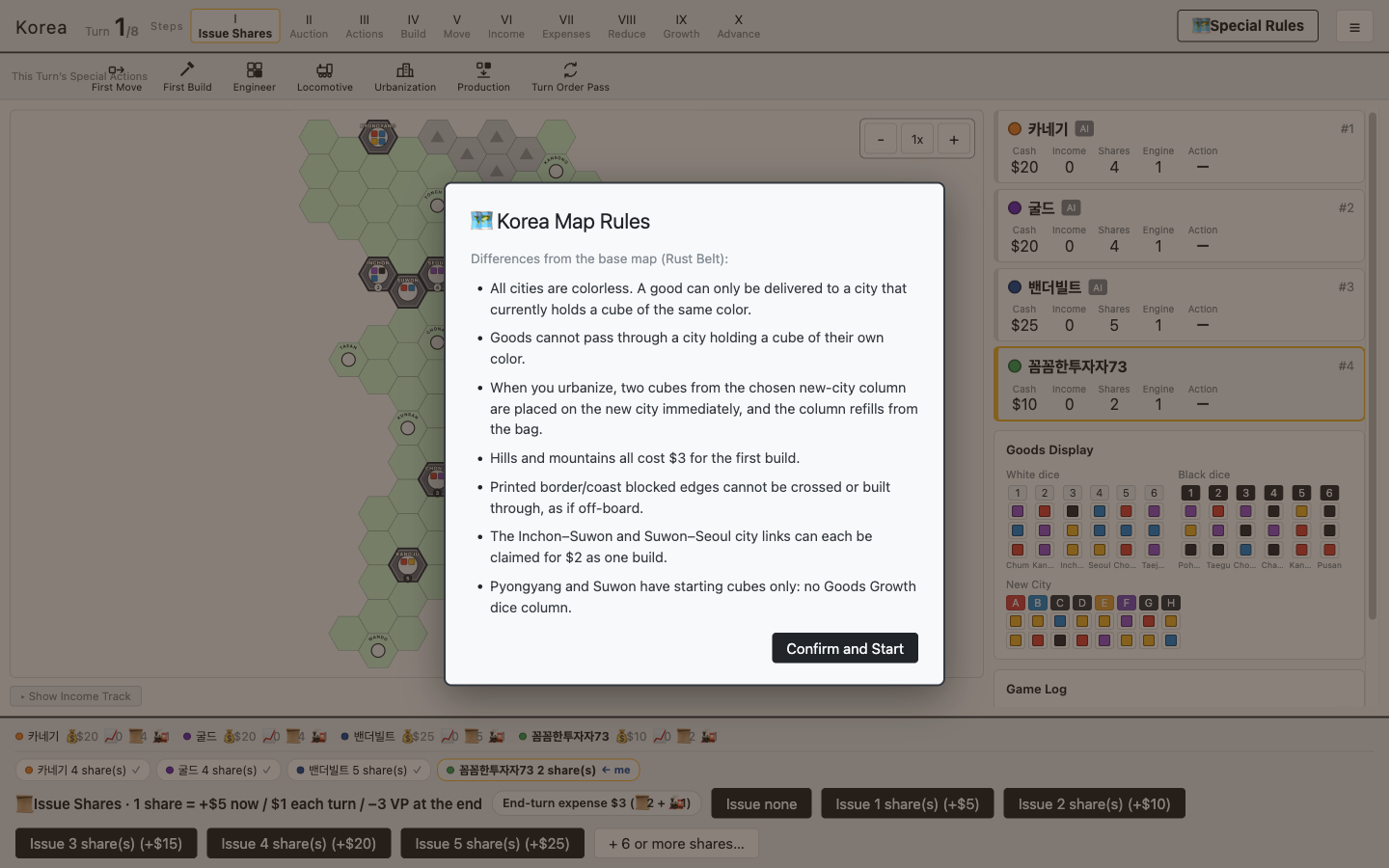
The popup at the start of a game lists the differences from Rust Belt:
- All cities are colourless. A good can only be delivered to a city that currently holds a cube of the same colour, and goods cannot pass through a city holding a cube of their own colour.
- When you urbanize, two cubes from the chosen new-city column are placed on the new city immediately, and the column refills from the bag.
- Hills and mountains all cost $3 for the first build.
- The Inchon to Suwon and Suwon to Seoul city links can each be claimed for $2 as one build.
- Pyongyang and Suwon have starting cubes only: no Goods Growth dice column.
What it means for a city to change colour
On other maps a city's colour is printed. Chicago is red and stays red. Here a city wants whatever cubes it holds right now. Tom Vasel's December 2004 review put it as cities constantly changing colour, often more than one at a time. A 2006 BGG review used one word, chaotic, and gave it nine out of ten.
Three things follow. Delivery plans last one turn: a 2013 session report from Malaysia sighs about a city that expected red and yellow suddenly wanting only red. Urbanization, which drops two cubes on the new city at once, is far stronger than elsewhere. And since wherever cubes gather is the market, demand does not follow the city; it appears wherever the railway reaches.
The $2 link is the Gyeongin line
The cheapest connections on the board are the two links from Inchon through Suwon to Seoul: a marker instead of track, $2 each. On 18 September 1899 the Gyeongin line ran 33 km from Inchon to Noryangjin on the south bank of the Han, the first railway in Korea. Begun by the American James Morse, sold to a Japanese company, and extended across a new Han River bridge into Seoul the following year. That this stretch is the cheapest and earliest link on the map is faithful. In the 2013 five-player report, every long delivery by the winner ran over it.
Starting cubes follow the order of the treaty ports. Only Pusan and Inchon start with three; Pyongyang has four. Pusan was the first port opened, in 1876, with a ferry to Shimonoseki from 1905. Inchon opened in 1883, got its lock dock in 1918, and in 1928 shipped 7 million of Korea's 17 million bushels of rice to Japan. Pyongyang was the centre of the western industrial belt, but on this map it has no growth die. Its cubes never increase.
A map that stops at Pyongyang
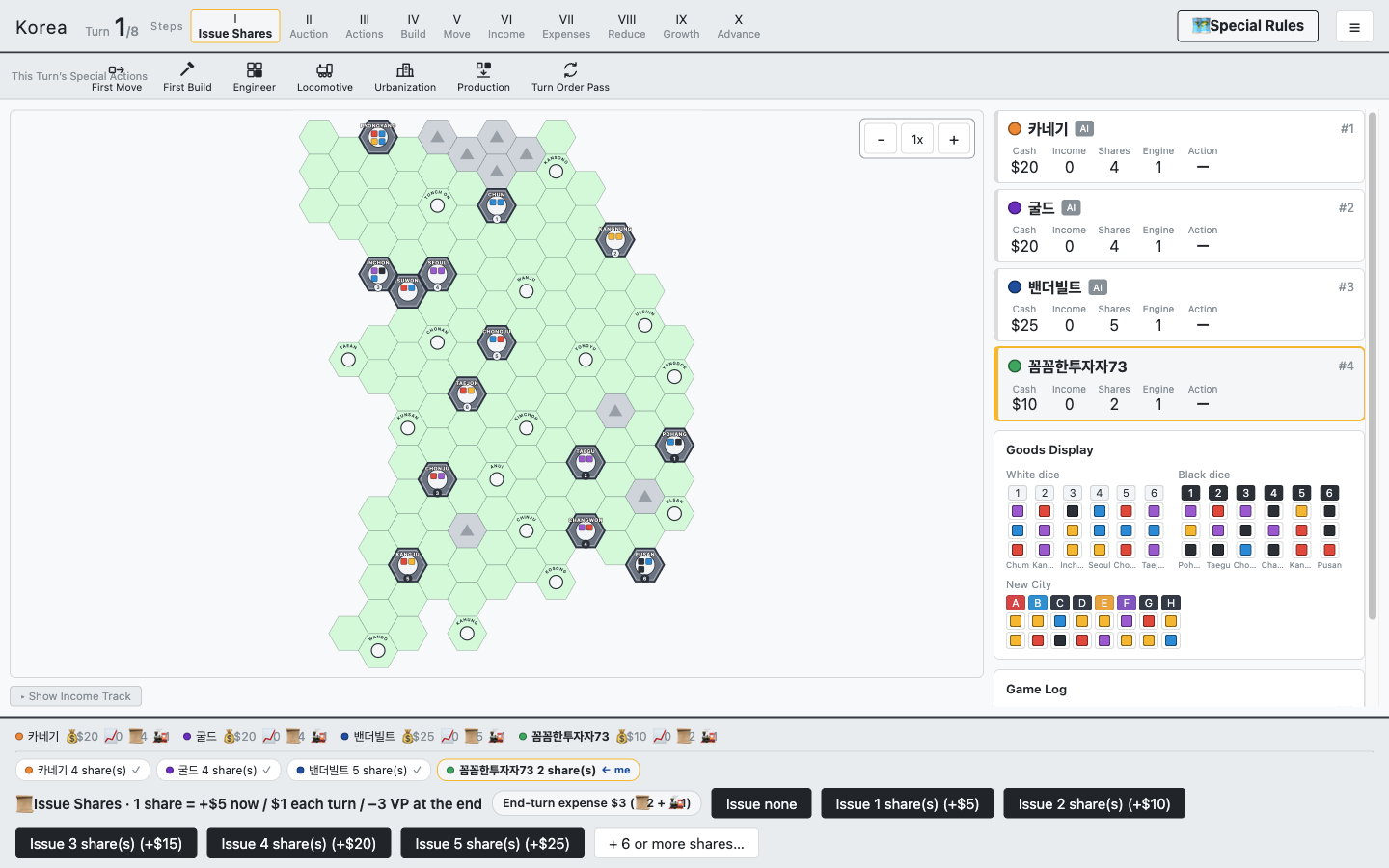
The northernmost city is Pyongyang. No Sinuiju, no Wonsan. The Gyeongui line reached Sinuiju as a military railway in 1905 and crossed the Yalu into Manchuria in 1911, but this board is cut off around the Taedong River. There is no evidence the designer meant the division. To anyone who knows today's rail map, where the Gyeongui line stops between Munsan and Kaesong and the Gyeongwon line ends at Baengmagoji, it reads that way anyway.
The south is dense by contrast. When the Gyeongbu line ran 441.7 km from Seoul through Taejon and Taegu to Pusan in 1905, Taegu became a transport hub, and on this map both Taegu and Taejon have their own growth dice. Seoul grew from 280,000 people in 1910 to 940,000 in 1940. Sixty-five hill hexes to 38 plains: the shortage of easy track is the terrain as it is.
A Korea map because Korea was a hit
In March 2004 James Hamilton of Warfrog told BGG two things: a Korean-language edition of 2,000 copies was being negotiated because Korea was a big market for the game, and October's Essen release would be a double-sided map, Scandinavia on one side and "a five-letter country" on the other. People guessed for fun. That became Expansion #3: Scandinavia and Korea, a limited run of 3,000. BGG credits Martin Wallace; rated 7.83 by 488 people, 733 logged plays.
The expansion is out of print and Korea appears in none of the Deluxe Expansion volumes I to VI. The Korean Deluxe Edition was published by Korea Boardgames in 2020, which is why this site's purchase link points at the Deluxe base game. Two other maps share the name, Alban Viard's "Las Vegas and Korea" (2012) and its 2025 revision "New Zealand and Korea"; they use different build costs north and south and are not this map.
So how do you play it
This site has nine finished games on the map so far (all human wins), so measurements only give a direction. Twenty years of community experience says:
- The Inchon seat is strong. Repeated across three Montreal group sessions. Three cubes with a $2 link attached.
- Do not save your urbanizations. Two cubes land on the new city at once. The 2004 review called the two-cube action "much more useful" for exactly this reason.
- Hills are $3 and plains are scarce. Positions are contested from round one; early routes start in the valleys around Seoul and Pusan and tunnel through the hills later.
- Four players. The 2013 five-player report concluded that five is brutal and the ideal count is probably four. This site recommends three or four.
- Grow the locomotive. Colourless cities will accept cubes from far away. A recorded win used a level-6 locomotive to pass 50 points.
One data correction. We spelled the south-western city Kangju; the 2007 photograph of the physical board reads Kwangju. That is Gwangju, and the map now reads Kwangju.
On video
- Tutorial Corea para Age of Steam (juegosmontt, 2020, Spanish): the only video devoted to the Korea map, a six-minute rules tutorial.
- Scandinavia 4-player playthrough (Heavy Cardboard, 2020): the other side of the same expansion. No English playthrough of the Korea side exists yet.
Sources
- BGG: Age of Steam Expansion #3: Scandinavia and Korea, Warfrog announcement thread (2004), 2006 review, Tom Vasel review (2004)
- Session reports: Montreal 2006, 2008, Hiew, five players, 2013
- Rules threads: hill cost, is Suwon a city
- History: Wikipedia (ko) Gyeongin line, Gyeongbu line, Gyeongui line, Busan Shimonoseki ferry, History of Incheon; Chosen Government Railway
- Other Korea maps: Las Vegas and Korea (2012), New Zealand and Korea (2025)
More strategy articles
- Age of Steam Strategy Guide: the Fundamentals, Then Your First Turn
- How Many Shares Should You Issue in Age of Steam?
- Which Age of Steam Map Is Hardest? Numbers from 246 Games
- Which Age of Steam Map Should You Play First?
- Survive Turn One and You Will Probably Finish
- Age of Steam, Steam, Railways of the World: One Game, Three Lineages
- Ireland: The Map Where the Cubes Emigrate
- Making the Bupyeong Underground Map: From a Guestbook Post to a Board in 42 Hours
- How We Trained the AI Opponents, and the Three Times It Went Wrong
- Rust Belt: Why the Default Map Is a Place That Had Not Rusted Yet
