Ireland: The Map Where the Cubes Emigrate
September 7, 2026
Every map has a rule twist. Most are about terrain. Ireland's twist is different: this map turns the country's nineteenth century into a rule.
What is different here
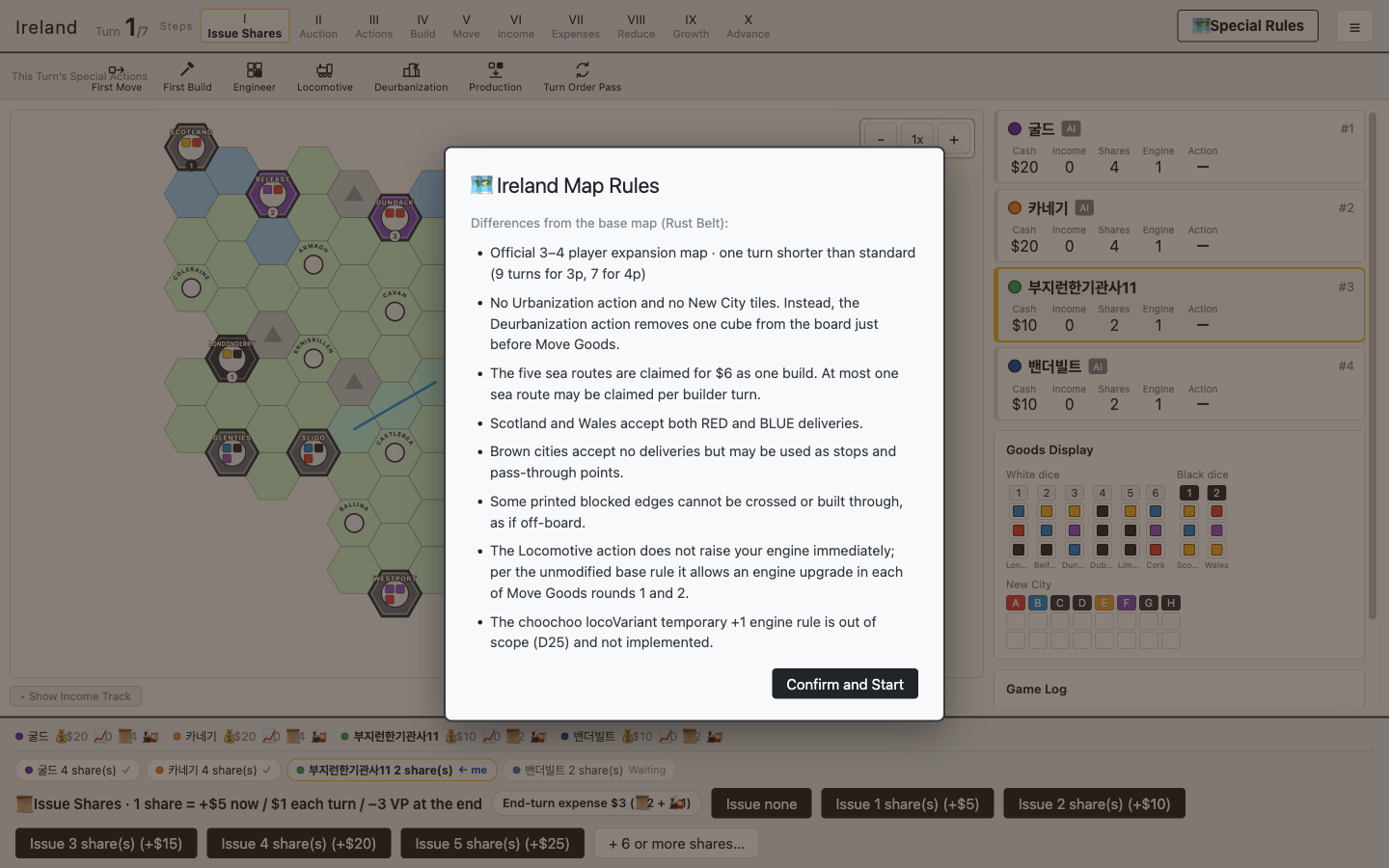
A popup appears when the game starts. The differences from Rust Belt, as it lists them:
- An official 3 to 4 player expansion map, one turn shorter than standard (9 turns for 3, 7 for 4).
- No Urbanization action and no New City tiles. Instead, the Deurbanization action removes one cube from the board just before Move Goods.
- Five sea routes are claimed with one build for $6, at most one per turn. Scotland and Wales accept both RED and BLUE.
- Brown cities take no deliveries; they only serve as stops and pass-throughs.
The map comes from the first expansion Warfrog and Winsome released in 2003 (Expansion #1: England & Ireland), on its Ireland side. BGG credits John Bohrer and Martin Wallace. The first review in 2003 read the brown hexes as declining industrial towns, and BGG's one-line blurb sums the map up: Ireland is vicious; people here steal goods instead of producing them. Note that the Ireland map in the 2026 Deluxe Expansion Vol. VI is a different, 2002 map, without Deurbanization or sea routes.
What it means for a cube to vanish
On other maps, Urbanization puts a new city on a town. The board grows. Here the same action slot runs the other way: pick up a cube and drop it in the bag. It is a denial move, taking the cube an opponent was about to deliver, and the community nickname for it is "the ultimate screw you". Forget to use it and the turn's action is simply gone.
Set the action against history and it stops being a denial move and becomes a story. Ireland's population peaked at 8,175,124 in the 1841 census. The Great Famine of 1845 to 1852 killed about a million and drove more than a million out. The leaving never stopped: 6.55 million in 1851, 5.4 million in 1871, 4.46 million in 1901. A little over half remained after sixty years. Emigration alone between 1855 and 1929 came to about five million.
A rule that returns one cube to the bag runs in the same direction as that curve. A board that does not grow, an island that empties.
The railway carried people to the ports
On this map, the only destinations for yellow, red and blue cubes are across the water. The five sea routes to Scotland, Wales and England are the only places that accept those colours. To deliver, you end up at a port.
So did history. Ireland's first railway, in 1834, ran 13.5 km from Dublin to Kingstown harbour. By 1848 there were 200 to 360 miles (sources differ); at the 1920 peak, about 3,400 miles, one of the densest networks anywhere. A 2022 study from Queen's University Belfast (Fernihough and Lyons) found that while the railway improved access to domestic markets, it improved access to ports just as much, and places that gained port access lost more people. The Cork to Cobh line opened in 1862; two and a half million emigrants sailed for North America from Cobh alone. Station to quay in 25 minutes.
Brown west, growing east
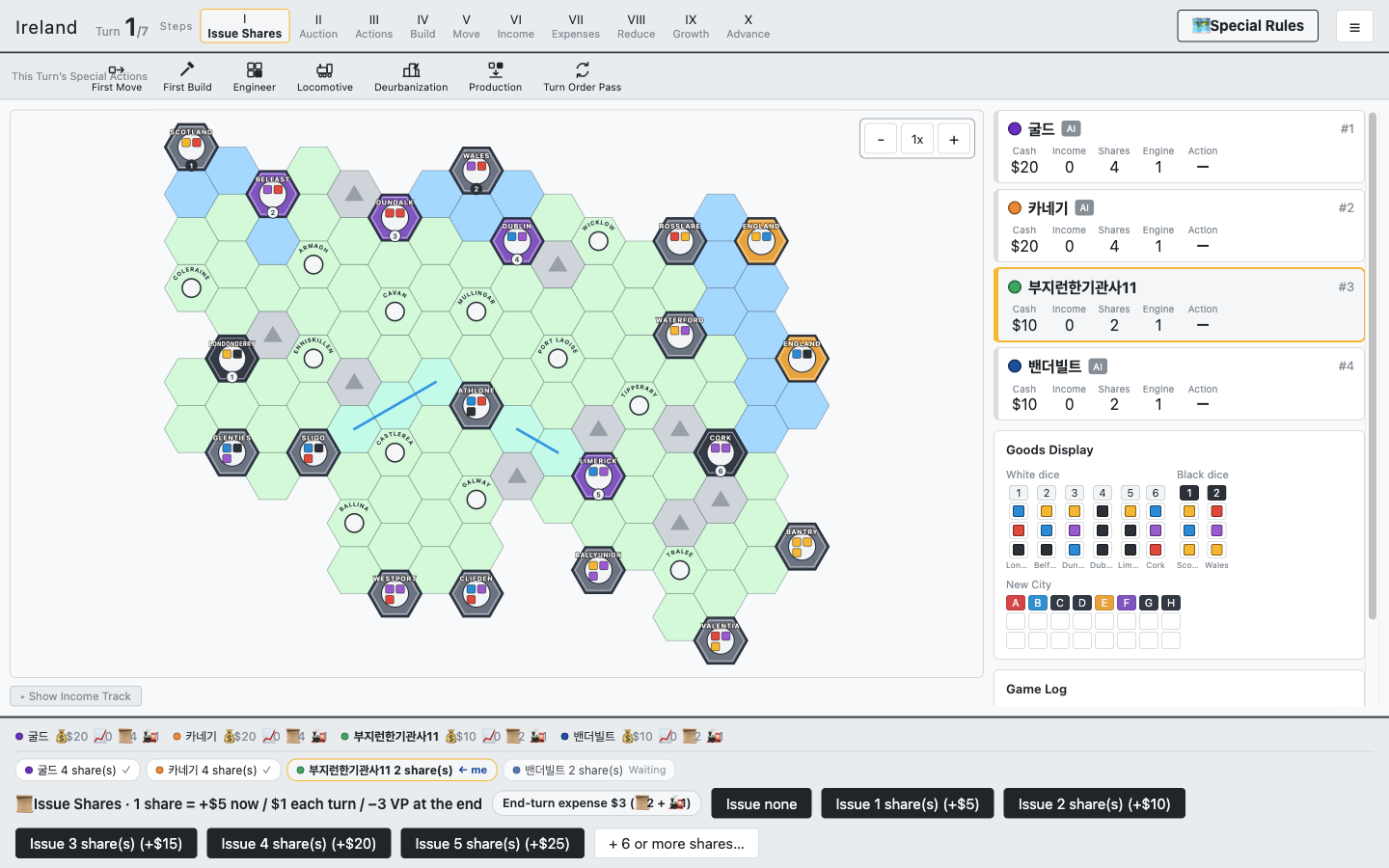
Look at the board and the ten brown cities are mostly in the west: Sligo, Westport, Clifden, Valentia, Bantry. They take no deliveries, and once their starting cubes are shipped out they stay empty. Only six cities have goods growth slots, all east or on a port: Londonderry, Belfast, Dundalk, Dublin, Limerick, Cork.
Put 1841 and 1901 side by side and the layout is not an accident. Connacht in the west lost 54% of its people in sixty years, and after 1880 about 60% of emigrants came from the south and west. Of the six growth cities, only one actually grew: Belfast, from 75,000 to 349,000, on linen and shipbuilding, overtaking Dublin around 1900. Dublin stood still, 234,000 to 291,000. Cork slipped from 81,000 to 76,000, Galway from 17,000 to 13,000, Limerick from 48,000 to 38,000. The map allows growth in six cities; history granted it to one.
So how do you play it
This site has only one finished game on this map so far, so there are no measurements. Here instead is twenty years of community experience.
- Look at the sea routes first. A 2006 review and the 2019 Heavy Cardboard playthrough reach the same conclusion: whoever claims the Scotland or Wales route, which accept both RED and BLUE, without competition, and keeps delivering along it, wins. $6 is cheap.
- Use Deurbanization just before an opponent's long delivery. It is not an action for your own deliveries; it cuts someone else's. As settled in a 2004 rules thread: once, right before Move Goods, and lost if forgotten.
- The money comes late. One line from the 2003 review is the whole economic history of this map: you will not make money until late in the game. You lay track on debt and the income arrives later, which makes this a poor map for debt-averse players.
- Not a first map. Heavy Cardboard's verdict too. Finish a Rust Belt game first, then come here. Deurbanization alone makes the trip worth it.
On video
- Age of Steam: Ireland 3-player teach and playthrough (Heavy Cardboard, 2019): map rules from about 35 minutes in. The player who monopolised the northern sea route won with 85 points.
Sources
- BGG: Age of Steam Expansion #1: England & Ireland, 2003 review, 2006 review, Deurbanization rules thread (2004)
- BGG: Age of Steam: Ireland (Deluxe Vol. VI, a different map)
- Wikipedia: Great Famine, 1841 census, population analysis, Connacht
- Encyclopedia.com: Migration and Emigration 1850-1960
- Dublin and Kingstown Railway, Rail transport in Ireland, Cobh
- Fernihough & Lyons (2022), QUCEH Working Paper 22-11
- City populations: Wikipedia Belfast, Dublin, Cork, Galway, Limerick (approximate; city boundaries differ between censuses)
More strategy articles
- Age of Steam Strategy Guide: the Fundamentals, Then Your First Turn
- How Many Shares Should You Issue in Age of Steam?
- Which Age of Steam Map Is Hardest? Numbers from 246 Games
- Which Age of Steam Map Should You Play First?
- Survive Turn One and You Will Probably Finish
- Age of Steam, Steam, Railways of the World: One Game, Three Lineages
- Making the Bupyeong Underground Map: From a Guestbook Post to a Board in 42 Hours
- How We Trained the AI Opponents, and the Three Times It Went Wrong
- Rust Belt: Why the Default Map Is a Place That Had Not Rusted Yet
- Korea: The Map Where Cities Have No Colour and the Cheapest Link Is the First Railway
